What should a computer remember?
At Nothing, we wanted to rethink some of the basic patterns of how we interact with a mobile device. We tried organising the phone around things that felt closer to how people actually think about their lives: people, places, projects and activities.
I kept looking back at older systems like Palm, where the core of the computer was built around your calendar, contacts, notes and tasks. It still had apps, but the structure felt much closer to what you were actually doing than to a collection of services installed on a device.
Phones already contain an enormous amount of information about our lives. The difficult part was deciding which of those signals actually mattered, then doing enough of that processing locally that the system could remain useful without constantly sending personal context to the cloud. Repetition became one of the simplest signals of importance: listening to Selected Ambient Works 85–92 once probably shouldn't make the system decide that you like ambient music, but if Aphex Twin, Floating Points and Four Tet keep appearing in what you listen to and save, that starts to mean something.
I designed and implemented a memory pipeline around this idea. A lightweight model filtered incoming information for useful events, then linked those observations to persistent entities in the user's knowledge graph rather than treating everything as an isolated memory.
The graph changed over time, with periodic jobs grouping related observations, merging duplicates, reconciling new information with what the system already knew and removing things that had become stale. The aim wasn't to remember everything, but to turn a noisy stream of activity into a smaller set of things that remained useful.
We split the work between the device and the cloud. Fast classification and filtering could happen locally, while operations that needed more context or model capacity could be offloaded. Which path we used depended on privacy, latency, compute cost and how much model capability the task actually needed.
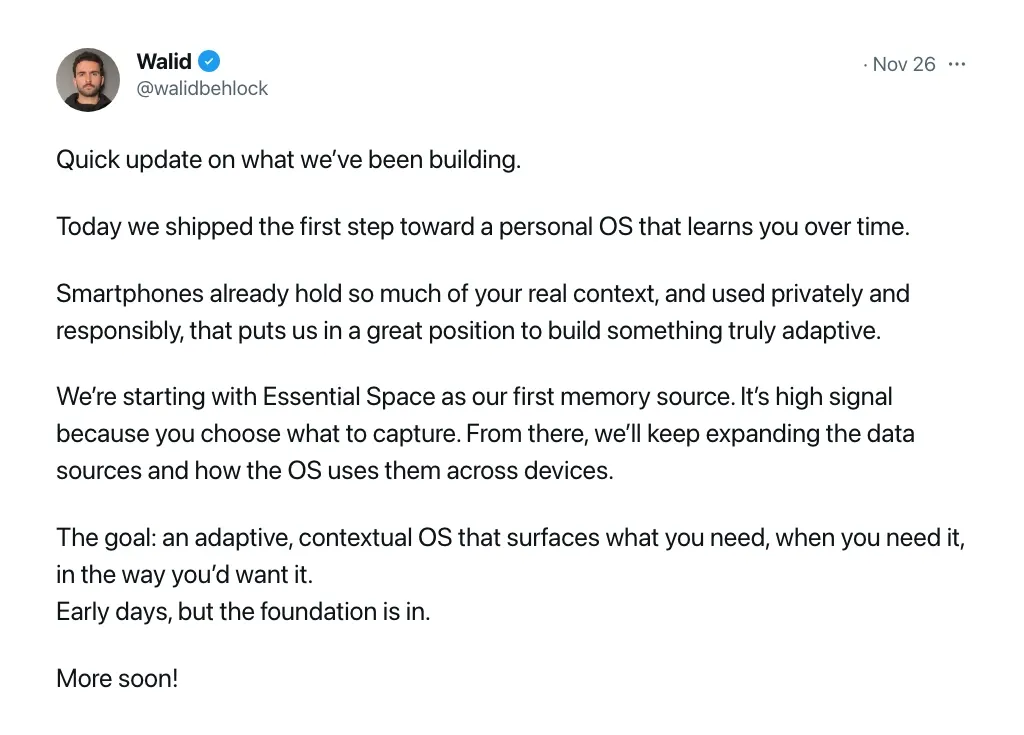
The first version of this system that we shipped to users came through Essential Space. Rather than trying to infer everything passively, we gave people an explicit way to tell the phone that something mattered. Capturing something on screen could bring both the content and some of its surrounding context into the user's personal knowledge graph, giving us a much cleaner signal than passive observation alone.
What a computer remembers shapes what it can find, suggest and do. I’m interested in how that understanding can evolve over time, and how people can shape what their computer remembers.